06Insurance reconciliation
Bordereaux Reconciler
Free demo — may take ~1 min to wake.
In short
- What it does
- Checks the monthly spreadsheets insurance partners send against the insurer's ledger, traces every figure to its source cell, and flags unclear rows for review.
- Why it matters
- Partners use different column names and number formats, and the errors that matter most do not look wrong.
- What I built
- Built an engine that works out each spreadsheet's layout on its own, keeps money exact, and gives every row a clear outcome.
- Key result
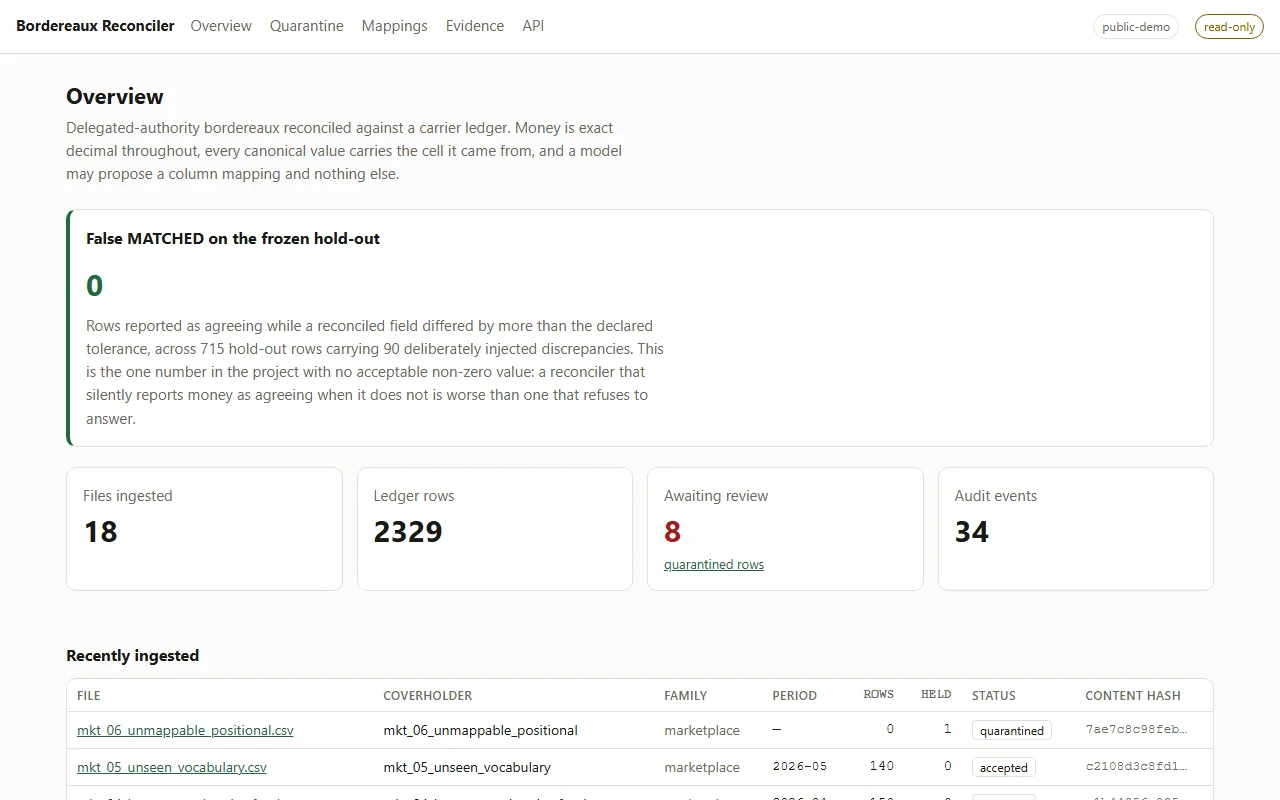
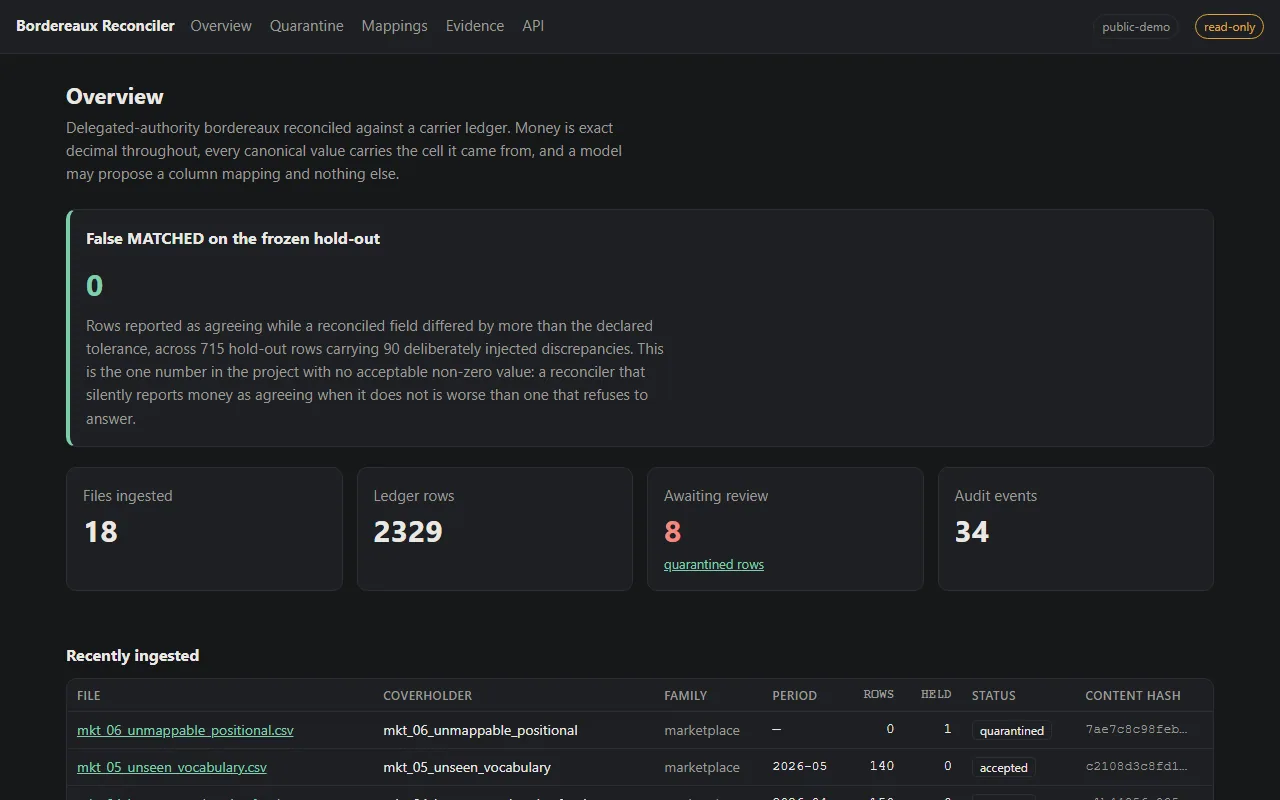
- Not one row was wrongly marked as matching in a held-back test set of 715 rows with 90 planted errors, and every row got exactly the status the answer key expected.
Overview
Insurance reconciliation where every canonical value carries the spreadsheet cell it came from, money is exact decimal throughout, and the one role a model is allowed — proposing a column mapping — is built but not wired in.
- Problem
- Coverholders send monthly bordereaux with no standard: one writes Gross Premium, another GWP (excl IPT), a third Total Payable and means something else. 1,234.56 and 1.234,56 are the same number written by different people and different numbers read by the wrong parser. Someone reconciles this by hand, and the errors that matter do not look wrong.
- Built
- Ingestion under conventions the coverholder declares, column mapping from the header and the shape of the values beneath it, canonicalisation to exact decimals with the source cell attached to every value, reconciliation into six statuses, a human-confirmation step for mappings, and Terraform for Azure that passes terraform validate in CI and has never been applied.
- Hard part
- Mapping headers nobody wrote down. Each column is profiled — share of amounts, dates, identifiers, closed vocabularies, magnitude rank among the money columns — and that evidence is combined with the header, so the mapping holds where header-string methods collapse.
Evidence
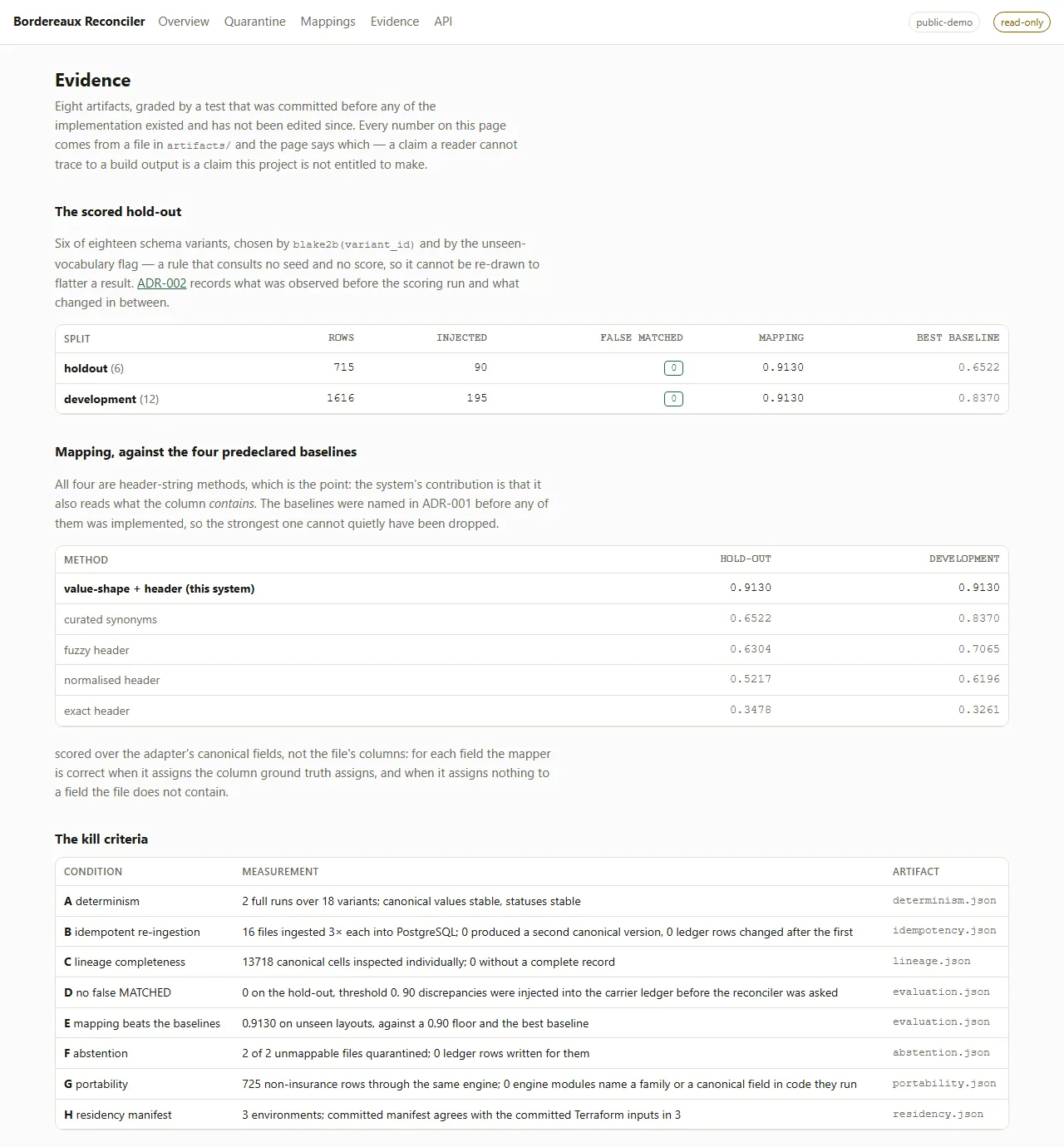
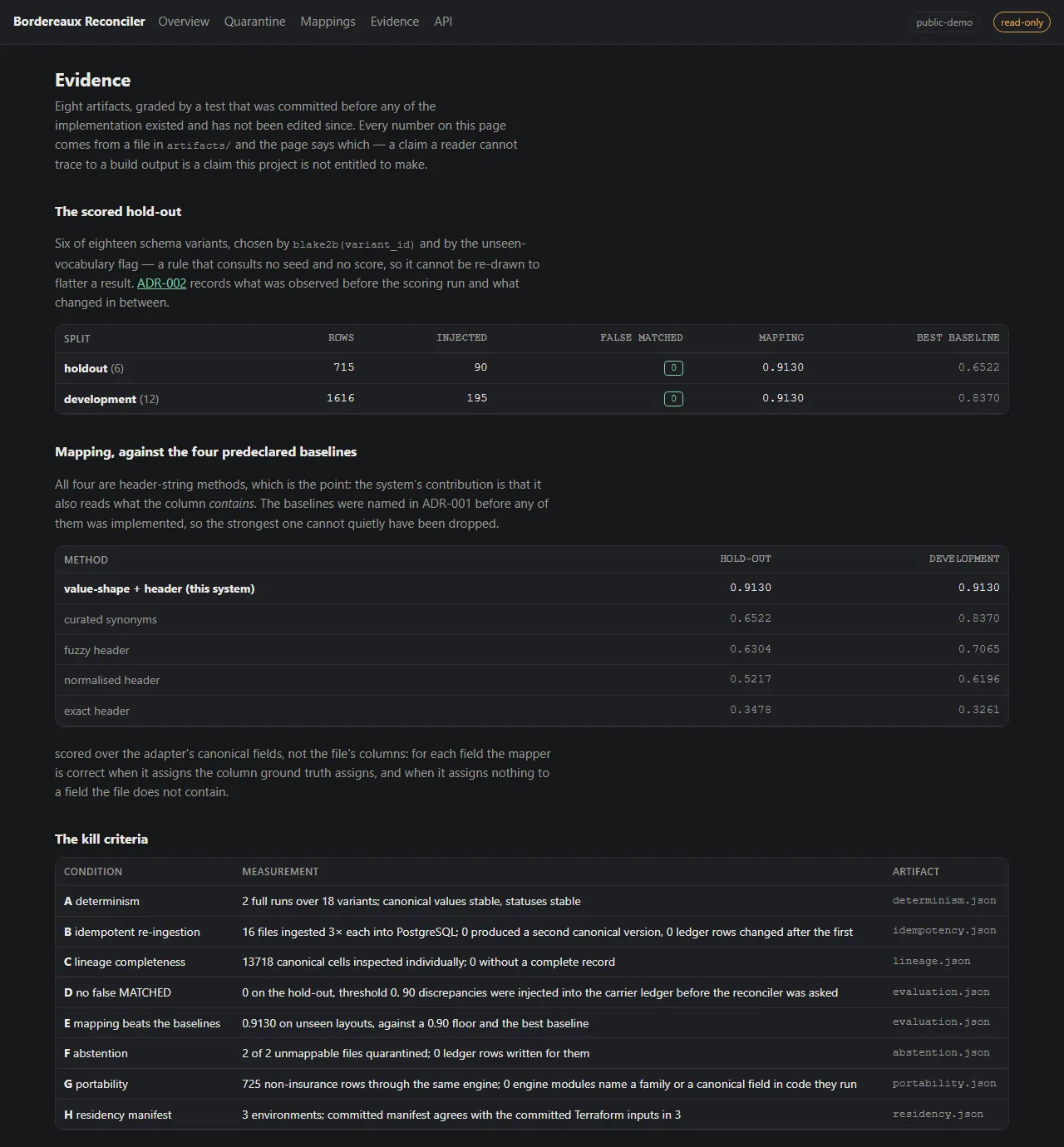
rows wrongly marked MATCHED in a frozen hold-out of 715 rows seeded with 90 discrepancies
column-mapping accuracy on the hold-out files; the best of four header-matching baselines reaches 0.652
Hold-out numbers were visible in debug output before scoring, so the project treats this figure as slightly weaker; the development figure is also 0.913.
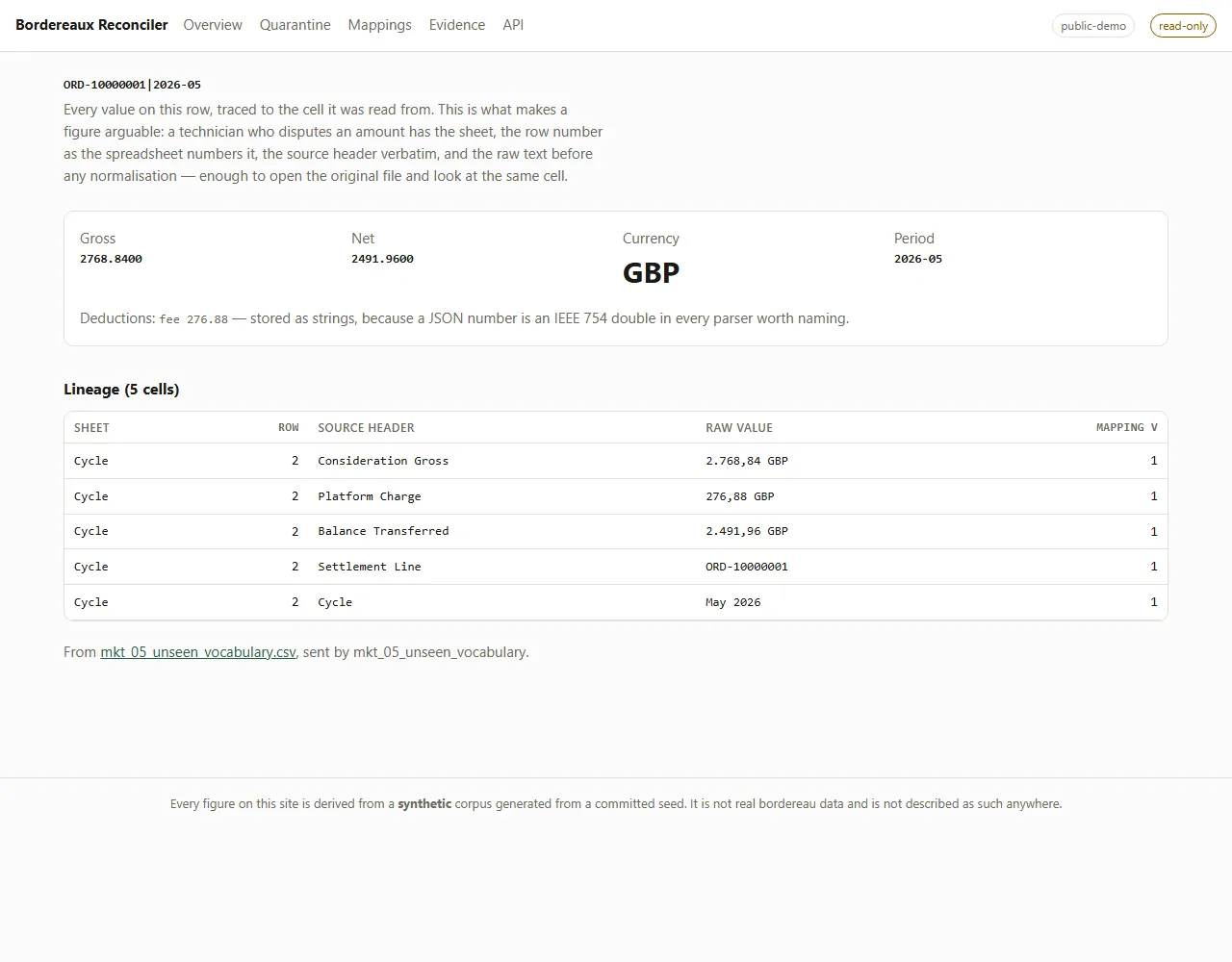
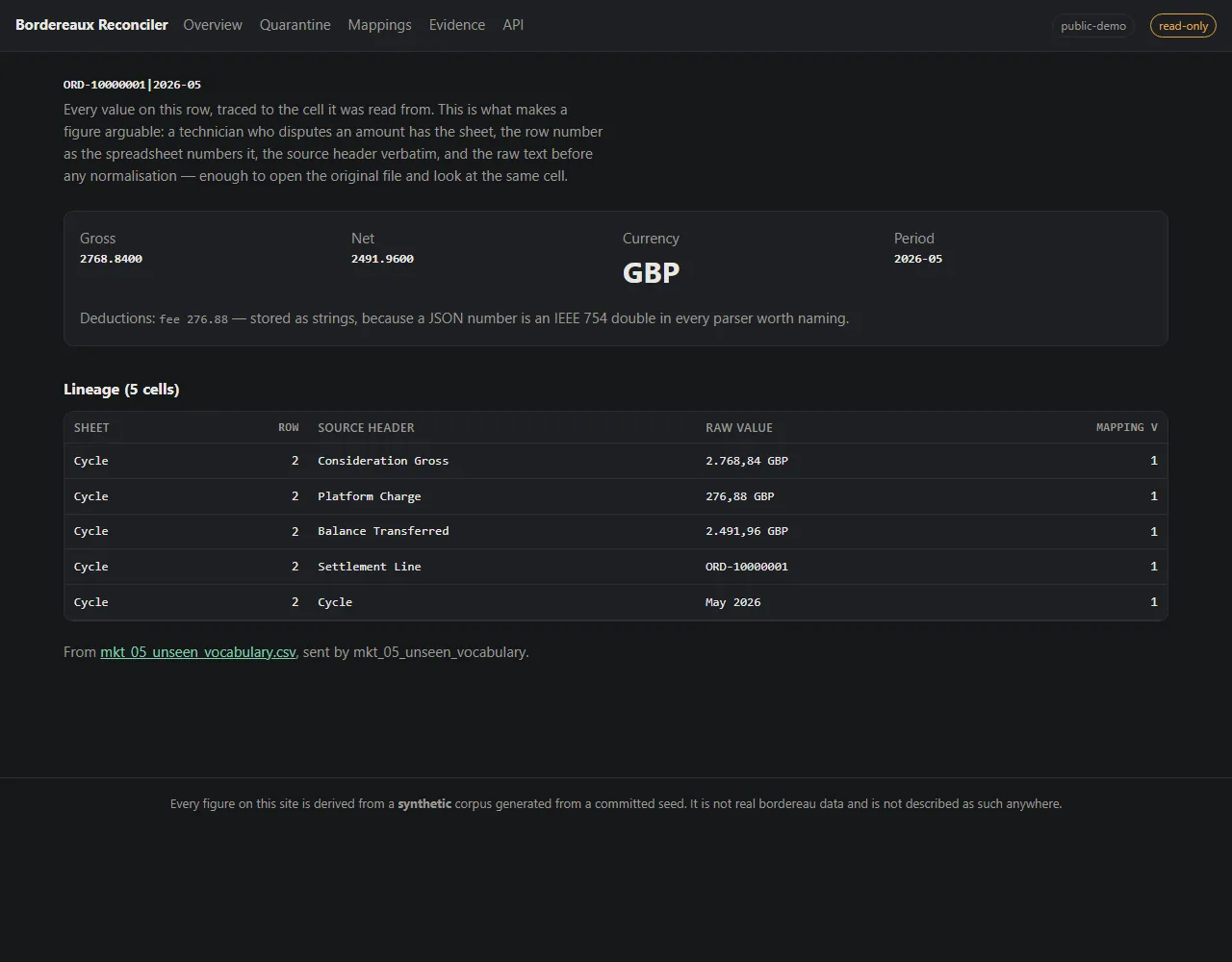
canonical cells traced to their source cell — 0 incomplete
planted defects caught
Column-mapping accuracy against four predeclared header-string baselines
| Method | Hold-out | Development |
|---|---|---|
| value shape + header (system) | 0.913 | 0.913 |
| curated synonyms | 0.652 | 0.837 |
| fuzzy header | 0.630 | 0.707 |
| normalised header | 0.522 | 0.620 |
| exact header | 0.348 | 0.326 |
The margin is wider on the hold-out (+0.26) than on development (+0.08): the hold-out carries the unseen-vocabulary variants, where header-string methods collapse and value-shape evidence does not.
Source: artifacts/ · graded by a kill test committed before implementation
Architecture
- 01Input
Coverholder file
CSV or XLSX · declared decimal and date conventions
- 02Code
Column profiling
value shape + header evidence
- 03Code
Column mapping
deterministic mapper · a model port may only name canonical fields, not wired in
- 04Human
Mapping confirmed
a person confirms · the demo's mappings are seeded
- 05Code
Canonicalise
exact Decimal + source cell on every value
- 06Store
PostgreSQL ledger
canonical rows · NUMERIC(18, 4) · lineage
- 07Gate
Reconcile vs carrier ledger
six statuses
Branch · Cannot be read exactly
- ↳01Human
Quarantine queue
a queue, not a bin
A row that cannot be read exactly is quarantined, never coerced.
Statuses: MATCHED, MISMATCH, MISSING, DUPLICATE, AMBIGUOUS, REVIEW. MATCHED is constructed in exactly one place in reconcile.py, and a test asserts it over the module's syntax tree.
- InputArrives from outside the system
- CodeDeterministic code
- HumanA person decides
- GateDecides whether work proceeds
- StoreDurable state
Engineering notes
Exact money, enforced at runtime
No premium, deduction or ledger amount is stored, parsed or compared as a float. The money module raises on a float at runtime rather than trusting the type checker, money columns in PostgreSQL are NUMERIC(18, 4), deductions are stored in JSON as strings, and rounding is half away from zero because that is what the finance systems a coverholder uses do.
Tolerances are configuration: a tolerance names the fields it covers, and a field it does not name requires exact agreement. No model, heuristic or scoring function can influence one.
Where the model is allowed to be
A model is confined to one permitted role: proposing a mapping from source columns to canonical fields, for a person to confirm. That port is built and tested but not wired in — the deterministic mapper produces every mapping. The proposal type has no field capable of holding money, the reconciler does not import the provider, and every proposal is validated against the canonical field set before a human sees it. A spreadsheet cell reading 'ignore previous instructions' is inert because a proposal can only name a field from a closed set.
Infrastructure as code, validated and not applied
Terraform composes a platform module into three environment roots — dev, bench and prod — declaring Azure Container Apps, Azure Database for PostgreSQL and keyless Blob storage that would hold the raw spreadsheets behind every lineage record. All three pass terraform validate against the real azurerm 5.6.0 schema in CI, and a committed residency manifest must match the Terraform inputs.
Nothing has been applied: there is no Azure subscription for this build, and the live demo runs on Render's free tier.
Screens
Limitations
As the project states them. Read these before relying on any number above.
- No Azure deployment exists: the Terraform is validated in CI and has never been applied.
- No live model call: the port, validation boundary and residency record are built and tested, but no live arm is wired in and no key exists, so no cost or latency is published.
- Hold-out numbers were visible in debug output before the scoring run (0.7826). The repository discloses every change made in between and asks sceptical readers to treat the hold-out figure as slightly weaker.
- Two development variants, multi-commission and split-tax layouts, get REVIEW instead of a decision: the adapter they need is not built.
- The demo's free Render PostgreSQL expires on 24 October 2026; after that only the evidence page keeps working unless the database is re-provisioned.
- The corpus is synthetic, generated from a committed seed; no redistributable real bordereaux exist.
Facts and stack
- Corpus
- 18 schema variants · 2,333 canonical rows
- Re-ingestion
- 16 files × 3, 0 second versions
- Portability
- 725 non-insurance rows through the same engine
- CI
- fast · terraform · evidence · falsifiability · docker
Stack
- Python 3.12
- FastAPI
- PostgreSQL 16
- SQLAlchemy
- Alembic
- openpyxl
- Terraform
- Azure — validated, never applied
- Docker
- GitHub Actions
- Render
Skills shown
- Insurance reconciliation
- Deterministic money
- Data lineage
- Human-confirmed mapping
- Terraform / IaC
- Residency manifest as code